The Agora of Smyrna—the forgotten forum of ancient Izmir, just a stone’s throw from the bazaar
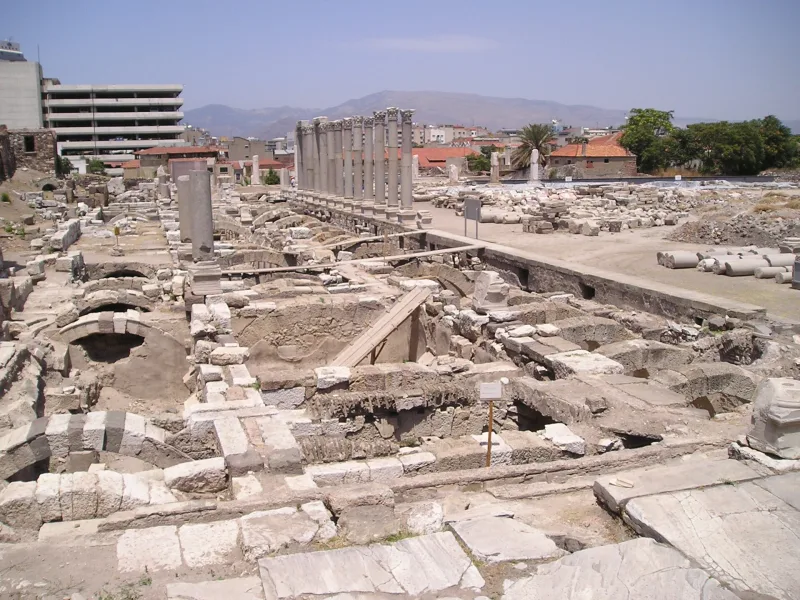
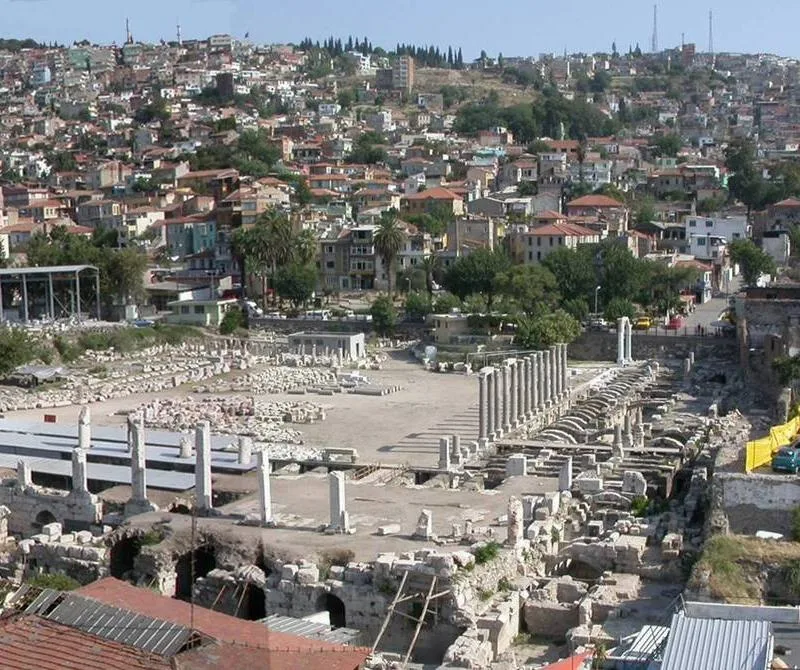
The Agora of Smyrna (Turkish: İzmir Agorası, English: Agora of Smyrna) is a rare example of an ancient city emerging not in an open field, but right in the middle of a modern metropolis. Stepping out of the bustling alleys of the Namazgiah quarter in the Konak district, the traveler suddenly finds themselves at the bottom of a vast stone pit: marble colonnades, stone arches of an underground basilica, the remains of the Faustina Gate, and fragments of an ancient street. The Agora of Smyrna was once the city square, the heart of the Greco-Roman city, and today it is one of the most underrated archaeological sites on Turkey’s Aegean coast. In 2020, the site was included on UNESCO’s tentative list as part of the “Historic Port City of Izmir” nomination, and it is here that one can best understand why Smyrna remained the pearl of Asia Minor for 1,500 years.
History and Origins of the Agora of Smyrna
Smyrna is one of the oldest cities in Asia Minor, with roots dating back to the 3rd millennium BCE. But the Smyrna whose ruins are visible today in the center of Izmir is already a “new” city, relocated to the slopes of Mount Pagos (now Kadifekale) in the 4th century BCE. There is a beautiful legend: Alexander the Great, who had stopped to hunt near the spring of the goddess Nemesis, was visited in a dream by the goddesses themselves, who ordered him to move Smyrna from its inconvenient old location. Upon waking, the commander ordered the oracle to confirm the omen, and the priests announced the will of the gods to the inhabitants. Thus, a new Hellenistic city appeared at the foot of Pagos, and with it—the public agora.
Researchers agree that the first agora was founded in the 4th century BCE and served as Smyrna’s main public square. Here, the city council held its sessions, trade took place, court rulings were handed down, statues were erected in honor of benefactors, and decrees were proclaimed. The Agora of Smyrna was not a marketplace in the everyday sense of the word—it was a political and civic arena, a public space rather than a commercial one, as Turkish archaeologists emphasize.
It is worth imagining what this square looked like on a holiday: a sea breeze rises from the bay, marble colonnades cast striped shadows on the stone slabs, street vendors selling nuts and figs wait outside the gates, and in the agora itself, a town crier reads the city council’s decree. As early as the 2nd century BCE, Smyrna was among the most important ports of the eastern Mediterranean, and its atmosphere was closer to that of the Athenian agora than to the bustling eastern bazaars.
Everything changed with the catastrophe of 178 CE. A massive earthquake destroyed a huge part of Smyrna, and the agora lay in ruins. The Roman emperor Marcus Aurelius, responding to a letter from the orator Aelius Aristides, ordered the city to be rebuilt—and it is this reconstruction that accounts for most of what can be seen at the excavations today. The city flourished anew, and Smyrna once again became one of the main centers of the Roman province of Asia.
During the Late Antique and Byzantine periods, the agora gradually lost its significance. During the Ottoman period, the area was converted into a Muslim cemetery and an open-air prayer area—a namazgah—after which the modern neighborhood is named. Beneath a layer of graves and tombstones, the ancient ruins have been preserved better than in many other cities, where marble was hauled away for centuries to be used as building material.
Systematic excavations of the Smyrna Agora began in 1932–1933 by Turkish and German archaeologists; in the following decades, they were conducted intermittently. In October 2023, a new 700-meter-long walking path was opened on the site, allowing visitors for the first time to easily walk around all the main structures.
Architecture and What to See
The Agora of Smyrna is not a single structure but an entire complex of buildings on several levels, stretching out in a rectangle at the foot of the hill. Information signs help visitors navigate the site, but to truly appreciate its scale, it’s best to bring a map or an audio guide.
The North Stoa and the Basilica
The most impressive part of the complex is the North Stoa, also known as the Basilica. It is a massive three-aisled building that once stretched more than 160 meters along the northern side of the square. Today, vaulted underground galleries remain, where you can descend and walk beneath the massive arches of Roman masonry. It is here that most of the famous “Smyrna graffiti” was discovered—inscriptions, drawings, games, and poems scratched into the plaster by city dwellers nearly two thousand years ago. This is a rare example of the “living voice” of an ancient citizen: ranging from declarations of love and advertisements to children’s scribbles.
The Western Stoa and the Corinthian Colonnade
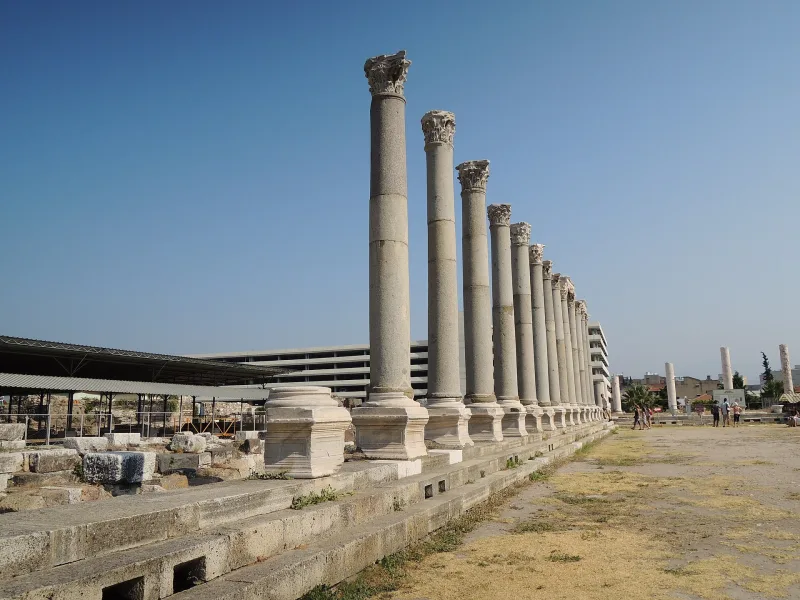
The Western Stoa is less well-preserved, but its foundations and rows of columns are clearly visible. The Corinthian colonnade, partially restored by archaeologists, gives an idea of the order and proportions of the square. The capitals with their characteristic acanthus leaves are a hallmark of Roman architecture in Asia Minor: the same forms can be seen in Ephesus and Aphrodisias, but in Smyrna they stand almost at the level of modern sidewalks, making it easy to examine them in detail. From here, the best view of the entire complex opens up: a neat rectangle framed by colonnades, with Byzantine and Ottoman superstructures along the edges, and in the distance—the minarets of neighboring mosques and the roofs of the shopping streets of Kemeralti.
The Faustina Gate and the Ancient Street
The Faustina Gate is a monumental arched passageway named after Marcus Aurelius’s wife. It led to the Ancient Street, paved with flat slabs and sloping toward Mount Pagos. Reliefs and traces of dedicatory inscriptions have been preserved on the arch. This is one of the most photogenic spots in the complex and the best illustration of how the Romans knew how to integrate a grand entrance into the dense urban fabric. Deep ruts from carts are visible on the street slabs—a favorite detail for those realizing for the first time that the ancient city was not a mere backdrop but a real, functioning infrastructure.
The Ottoman Layer and the House of Sabbatai Zevi
The Ottoman cultural layer is a story in itself. Fragments of a 17th–19th-century Muslim cemetery with characteristic tombstones shaped like a turban have been preserved at the edges of the excavation. Nearby, just outside the ören yeri, stands the famous House of Sabbatai Zevi—the 17th-century messianic rabbi born in Smyrna who led one of the largest mystical movements in the history of Judaism. The combination of ancient ruins, Muslim graves, and Jewish messianic history within a few hundred meters is a pure portrait of Smyrna as a city of three continents and three religions.
Interesting Facts and Legends
- According to legend, New Smyrna on the slopes of Mount Pagos was founded by Alexander the Great himself after a prophetic dream in which the goddess Nemesis commanded him to relocate the city—and the city’s agora became the center of this new polis.
- The Smyrna graffiti on the plaster of the North Stoa is one of the largest collections of ancient “everyday inscriptions” in the Mediterranean: among them are poems, love letters, drawings of ships, and even markings for board games.
- Emperor Marcus Aurelius—author of *Meditations*—personally oversaw the reconstruction of the agora following the earthquake of 178 CE. In gratitude, the city erected statues and dedicatory inscriptions in his honor.
- During the Ottoman era, the ancient square was used as a namazgah—an open-air Muslim prayer area—and as a cemetery; it was this “protective layer” that saved most of the marble from looting.
- In 2020, the Agora of Smyrna became part of the UNESCO candidate site “Historic Port City of Izmir,” and in October 2023, a new 700-meter-long walking path was opened here, making exploration significantly easier.
How to get there
The Smyrna Agora is located in the very center of Izmir, in the Konak district, a 10–15-minute walk from the Kordon promenade and the legendary Kemeraltı Bazaar. The easiest landmark is the Saat Kulesi clock tower on Konak Square: from there, walk up the streets of the Namazgiah neighborhood, and after a few turns, you’ll come to the fenced-off excavation site.
From Izmir Adnan Menderes Airport (ADB), the most convenient way is to take the İZBAN commuter train to Alsancak or Hilal station, then the M1 metro to Konak or Çankaya station, followed by a 5–10-minute walk. The drive from the airport takes 30–45 minutes depending on traffic; it’s best to look for parking near the waterfront rather than in the narrow streets of the historic district.
There are regular buses and İZBAN trains from Ephesus and Selçuk to Izmir; the trip takes 1.5–2 hours. From Kusadasi, it’s convenient to take a bus via Selcuk. Within Izmir, all the main attractions—the Agora, Kemeralti Bazaar, Kadifekale Fortress, and the waterfront—are connected by short walking paths and short tram routes.
Tips for travelers
The best time to visit is spring (April–May) and fall (September–October). In the summer, during July and August, Izmir heats up to over 35 degrees, and the exposed marble slabs become scorching by midday. It rains in winter, but the agora is nearly empty and especially beautiful in the soft, slanting light.
Allow 1–2 hours for your visit. Bring water, a hat, and comfortable shoes—the ground is uneven marble and dirt, and slippery in places. The new 700-meter path from 2023 significantly simplifies the route, but it cannot yet be called fully wheelchair-accessible: there are steps in the basilica’s underground chambers.
For Russian-speaking travelers, the best way to plan your itinerary is as follows: in the morning, take a leisurely stroll through the excavations, then head down to Kemeralti—one of Turkey’s oldest bazaars, where you can easily lose yourself for half a day—have lunch at a traditional lokanta (try Izmir köfte, midye dolma, and boyoz), and in the evening, head out to the Kordon promenade to watch the sunset. For contrast, it’s worth climbing up to Kadifekale Fortress—according to the legend of Alexander, this is where the city was relocated.
If you have another day or two to spare, it’s convenient to take a day trip from Izmir to Ephesus and Selçuk or to Pergamon in the north—together with the Agora, they form a sort of “Asia Minor triangle” of ancient architecture. An interesting parallel for a Russian traveler: in terms of its location within a modern metropolis, the Agora of Smyrna resembles Moscow’s Zaryadye or St. Petersburg’s Okhtinsky Cape—a rare instance where archaeology coexists with residential neighborhoods, a market, and a waterfront, rather than being relegated to the outskirts of the city. Because of this, you can spread your visit over several trips: stop by for half an hour in the morning, drop in again in the evening, and take a break between the bazaar and the café on the Kordon.
Useful tip: admission to Agora Smyrna is included in the “Müzekart”—an annual pass from the Turkish Ministry of Culture that pays for itself after just 3–4 sites. If you also plan to visit Ephesus, Pergamon, and Aphrodisias, the card is practically a must-have. The Agora of Smyrna isn’t the most hyped, but it’s one of the most authentic museums on the Aegean coast: there are no crowds, no “Disney-style” reconstructions, just a real ancient city whose stones still echo with the living voices of its inhabitants.